
Strike goes on at World Cup stadium

Unless the Ethekwini Municipality pushed the company building Durban’s 2010 stadium to pay its workers decent wages, the labour strike would continue — a move which will affect the deadlines set by world soccer controlling body Fifa , the Congress of South African Trade Unions (Cosatu) said last week.
Location may be key to PetroSA’s R39bn oil refinery project

On the face of it, the R39bn oil refinery that state corporation PetroSA plans to build at the Coega industrial development zone outside Port Elizabeth will bring much-needed additional refining capacity to an industry straining to provide growing demand for liquid fuel
WBHO full year HEPS up

Construction group Wilson Bayly Holmes Ovcom (WBHO) on Monday reported 512.1 cents in headline earnings per share (HEPS) for the year ended June compared with 351.7 cents a year ago.
 A final dividend of 85 cents per share (2006: 54 cents) has been declared which, together with the interim dividend of 36 cents per share, gives a total dividend of 121 cents for the year - up from 81 cents a year ago.
Revenue rose 40.3% to 8.1 billion rand and operating profit surged 58.6% to 415.8 million rand.
The group's building and civil division, which plays a major role in preparing the country for the 2010 Fifa World Cup, increased turnover by 31% from 4.4 billion rand to 5.7 billion rand in 2007. Operating profit increased by 47% to 222 million rand.
"We are partners in joint ventures which have been awarded contracts for the construction of the King Shaka International Airport, as well as the soccer stadia in Durban, Cape Town and Polokwane. Because of the early stages of these contracts no profits have been recognised in these accounts," the company said.
In addition, the group is engaged in major works at OR Tambo International Airport as well as the construction of shopping centres, office and apartment blocks and hospitals throughout the country.
It has recently been awarded in joint venture the One and Only Hotel in the Cape Town Waterfront.
However, in Australia, turnover has been relatively flat compared to 2006, but Probuild Constructions nevertheless increased profits by 11%, the company noted.
"There are indications that the market is improving in Melbourne and the order book is at a reasonable level," the group said.
Basic Constructions, the group's cvil engineering company in Brisbane, experienced a busy year with turnover increasing by 22%.
"Our activities in Sydney also showed significant growth and we have strengthened our foothold in this large but competitive market," the company said.
The road and earth works division's turnover of 1.9 billion rand was 61% higher than last year. Operating profit increased by 7% from 71 million rand to 76 million rand but with margins declining from 6.1% to 4%.
"Work for the mining sector has increased, providing good opportunities for additional work for the division. The division is also contracting in the DRC, Ghana, Zambia and other SADC countries," the group said.
Looking ahead, the group said its outlook for the construction industry remained positive with prospects for new work more likely to arise in the civil engineering sector than in the building sector.
"We believe we are well placed to benefit from this shift in the industry," the group said.
The company is starting the 2008 financial year with an order book of 10.6 billion rand ? from 6.1 billion rand last year.
"The nature of our order book has changed with a greater number of large contracts spread over longer time periods," the group said.
Bags of opportunity?
Women's empowerment group Wiphold and a Cape Town-based construction company, Coessa, say they will start to import cement from China at "competitive prices" in coming months.
Wiphold finance director Tryphosa Ramano says it is not possible to calculate a stable price for the cement because it is exposed to the rand-dollar exchange rate. It is currently possible to land cement in Durban for US$40/t. "But this doubles with handling and bringing the cement up to Gauteng," Ramano says.
Wiphold has formed a joint venture with Tangshan Jidong Cement (Jidong) to import a cement called Dunshi.
Coessa director Adam Essa says since news broke of his company's supply deal with Singapore-based Evermont International, he has taken at least a dozen orders totalling tens of thousands of tons.
He will not divulge the landed cost of the product but says he expects to sell it for about $93/t. At the present rate of R7,13, a 50 kg bag of this cement will sell for R33,50. Local building suppliers are charging R50-R60. A year ago the price was R36.
Evermont MD Lim Hong Siang has "conservatively calculated" SA's annual cement shortage to be over 5 Mt. "The four big companies in SA are currently producing 13 Mt-14 Mt annually. According to statistics, total usage is set to be around 20 Mt this year."
Independent industry analyst Mark Kingham disputes these numbers. "I don't know where they get them," he says. "The SA cement market is broadly in balance. The supply situation is tight, I agree, but we are nowhere near a 5 Mt shortage."
Kingham says new capacity which will start to come on stream in the next nine months will gradually reduce the need for imports. Already it appears that Pretoria Portland Cement (PPC) will need to import only half the cement it previously predicted. Kingham adds: "If you're importing cement, you're transporting a dead weight. These container ships also leak like colanders, so even if the bags don't break there is a good chance there is going to be spoilage."
Lafarge SA CEO Albert Corcos says a previous attempt by his company to import Chinese cement "translated into a loss". Lafarge's experience shows that if it had managed to get all its logistics right, even cement supplied to coastal regions would have been cost-neutral. "As soon as you start hauling it, you start losing money. Transport is not cost-effective."
JP Morgan analyst Marc ter Mors says it is possible to make money on Chinese cement imports but doubts it can be achieved consistently. A rise in shipping rates from China or a dip in the rand's strength would wipe out profits. "It's a low-margin business and it is likely that they will make margin only in the coastal areas," Ter Mors says.
He agrees with Corcos that once cement is moved to Gauteng, where demand is strongest, transport and handling costs are too high.
"It is possible that at a certain point in time you will be able to make money on the imports but it is questionable whether that can be done sustainably."
He adds that companies have gone bust in Namibia after underestimating the complexity and cost of importing cement. "I think it would be quite difficult to build a sustainable business out of this." However, he adds that if local companies continue to push up prices - some have risen by as much as 20% this year - importers will have a better chance of profit.
Wiphold appears to be aware of some of the challenges. "SA is not geared for the importing of cement," admits Ramano, but she says that because Wiphold has no overhead costs associated with importing the product, there is less pressure on margins.
She admits Wiphold has not yet found any customers. "You don't get commitments until you can guarantee continuity of supply," she says.
Wiphold expects to take delivery of a first shipment in October. It hopes customers will make their own collection and transport arrangements. If not, it hopes to get Grindrod or Spoornet to offer bulk services.
Lack of customers is not the only problem facing Wiphold. Ramano says the Durban port's warehouse facilities are limited and can handle only 25 000 t/ month of cement.
Importing cement from China is Wiphold's first step to cash in on the rapid acceleration in infrastructure investment. Ramano says it is investigating the possibility of building a cement-making plant with Jidong.
Until then, the partners will have their work cut out bringing in the cement. Kingham says: "If it was easy to make money by importing cement, the big guys would have done it ages ago. "
Acsa signs R6.8bn contract for La Mercy airport

Developing a new airport is a first for Acsa with the La Mercy project being the biggest the company has ever embarked upon
Wild Coast N2 delay has cost communities up to R2bn

The four-year delay of the proposed Wild Coast N2 has deprived the Pondoland communities of about R2-billion in spin-offs
Grinaker group still hoping to build King Shaka airport
Construction firm Grinaker LTA was excluded from the bidding process to build the King Shaka airport in Durban because it could not commit to the black-economic empowerment procurement required by Airports Company of South Africa (Acsa)
Contractor commences R733m Krugersdorp Casino
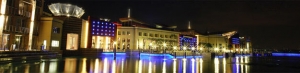
The Silverstar Casino Resort will comprise three gaming venues – the main casino, smokers’ casino and a VIP casino.
First of string of gyms launched in Jo'burg

A company has officially launched the first of several full-facility gyms planned for the city centre
Building on tight deadline for 2010

Danny Jordaan has admitted that the completion dates for the upgrade and construction of 10 stadiums are tight

eProperty News is a leading online commercial property marketplace serving the Southern African Investment, Office, Retail and Industrial property and allied sectors.