
This low level of economic growth was largely the result of prolonged strike action in the automotive sector, which adversely affected manufacturing output.
Real GDP growth of 2,7% is forecast for 2014 in view of a growing world economy, which will, together with a weaker rand exchange rate, contribute to faster export growth compared with 2013.
Headline consumer price inflation averaged 5,7% in 2013, with inflationary pressures coming from rising transport and property running costs, a depreciating rand exchange rate and above-inflation wage hikes.
Headline inflation is expected to average 6,2% in 2014. Domestic interest rates remained unchanged throughout 2013, but were hiked in early 2014 on the back of a depreciating exchange rate.
The forecast is for interest rates to rise further this year.
The consumer sector continued to experience financial strain during the course of
2013, with growth in real income and consumption expenditure remaining low on the
back of subdued employment growth.
The savings ratio not showing any improvement, the number of credit-active consumers with impaired credit records rising somewhat further up to the third quarter of the year and consumer confidence remaining at an extremely low level up to the end of the year.
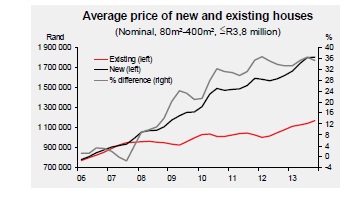
After being on an upward trend in the first half of 2013, nominal and real year-on-year house price growth in the middle segment of the market was lower in the second half of the year.
However, nominal and real price growth was higher for the full year compared with 2012.
In both the categories of affordable and luxury housing nominal price growth occurred in 2013, although prices deflated in real terms in these two segments of the market from 2012.
Recent trends in and prospects for the economy, interest rates, household finances, consumer confidence, house price growth and property market-related factors in general, point to a continuation of single-digit nominal price growth in 2014-15.
Real house price growth will be the result of the combined effect of nominal price trends and inflation, with real price deflation expected this year and next year.
Household sector overview
The consumer sector continued to experience financial strain during the course of 2013, with growth in real income and consumption expenditure remaining low on the back of subdued employment growth.
The savings ratio not showing any improvement, the number of credit active consumers with impaired credit records rising somewhat further up to the third quarter of the year and consumer confidence remaining low up to the end of the year.
Growth in real household disposable income, i.e. aftertax, inflation-adjusted income, was recorded at an annualised rate of 2,1% in the third quarter of 2013, down from 2,8% in the second quarter.
The decline in already relatively low real income growth was the result of the combined effect of tight labour market conditions and upward pressure on inflation.
According to Andrew Levy Employment, the nominal wage settlement rate averaged 7,9% in the first three quarters of 2013 compared with 7,4% in the corresponding period a year ago.
House prices
After being on an upward trend in the first half of 2013, nominal and real year-on-year house price growth in the middle segment of the market (homes of 80m² ─ 400m² and priced up to R3,8 million in 2013) was lower in the second half of the year.
However, middle-segment nominal and real price growth was higher for the full year compared with 2012.
In both the categories of affordable and luxury housing nominal price growth occurred in 2013, although prices deflated in real terms in these two segments of the market compared with 2012.
House price trends continued to be driven by property market conditions and related factors, which were affected by a combination of macroeconomic developments, the state of household finances and the level of consumer confidence.
The nominal price of a property refers to the price at which it was valued or transacted on the open market, i.e. the market price, selling or purchase price.
The nominal price is reflected in a valuation, an offer to purchase, an application for mortgage finance and in the transfer documentation at registration.
The property market
The performance of and prospects for the residential property market will continue to be closely related to economic growth, employment and household income growth, property running costs and living costs in general, interest rates, consumers' credit-risk profiles, banks' risk appetite and lending criteria and consumer confidence.
These factors will affect the affordability of housing and mortgage finance and will be reflected in property demand and supply conditions, price trends, market activity, buying patterns, transaction volumes and the demand for mortgage finance.
In view of current trends in and prospects for the major economic and household finance-related factors, as well as recent trends in house price growth, continued single-digit nominal price growth is forecast for 2014 and 2015.
Real house price growth will be the result of the combined effect of nominal price trends and
inflation, with real price deflation expected this year and next year.

